
Today, it was Principal Jan Gaffney’s turn to observe and assist, watching carefully to ensure students handled cleavers properly and safely, or whether they used they needed more attentive guidance….
Listen…Hear the Waves of Montessori Emanating From the Seaside
Montessori Elementary School Tuition-Free Teacher Training Program: Opening the Minds of Educators
We Don’t Just Chat About Montessori but Actively Seek to Make It Part of Employees and Parents’ DNA
More Than Physical Education—Fang-Jou Chang’s Dream
A Montessori Education Practitioner—Zheng-Hua Yan’s Education in Action
From Professional Manager to Education Advocate
It Takes a Village to Raise a Child
Home-School Educational Partnerships Help Children Become Themselves
Interview with Nicky Ma, Founder of Utopia Montessori School
There are 24 hours in a day. Children prepare for school at 7:00 a.m. and don’t come home till 4 or 5 p.m. Plus, traditionally, junior high school students often have to take supplemental classes, so children end up spending eight to nine hours a day at school.
How can parents better understand their children and build positive school rapport?
Nicky Ma has served in the Montessori educational system for over 20 years. After receiving Montessori teacher training, she founded Utopia Montessori School for children ages 0-12.
She is also the mother of two children. Recently, her son left home for the first time to study at a Montessori middle school in Zhudong. Ms. Ma, who herself has taken on many different roles, is especially attuned to the trilateral relationship between teachers, parents, and schools.
It begins with “us”—becoming an educational partner
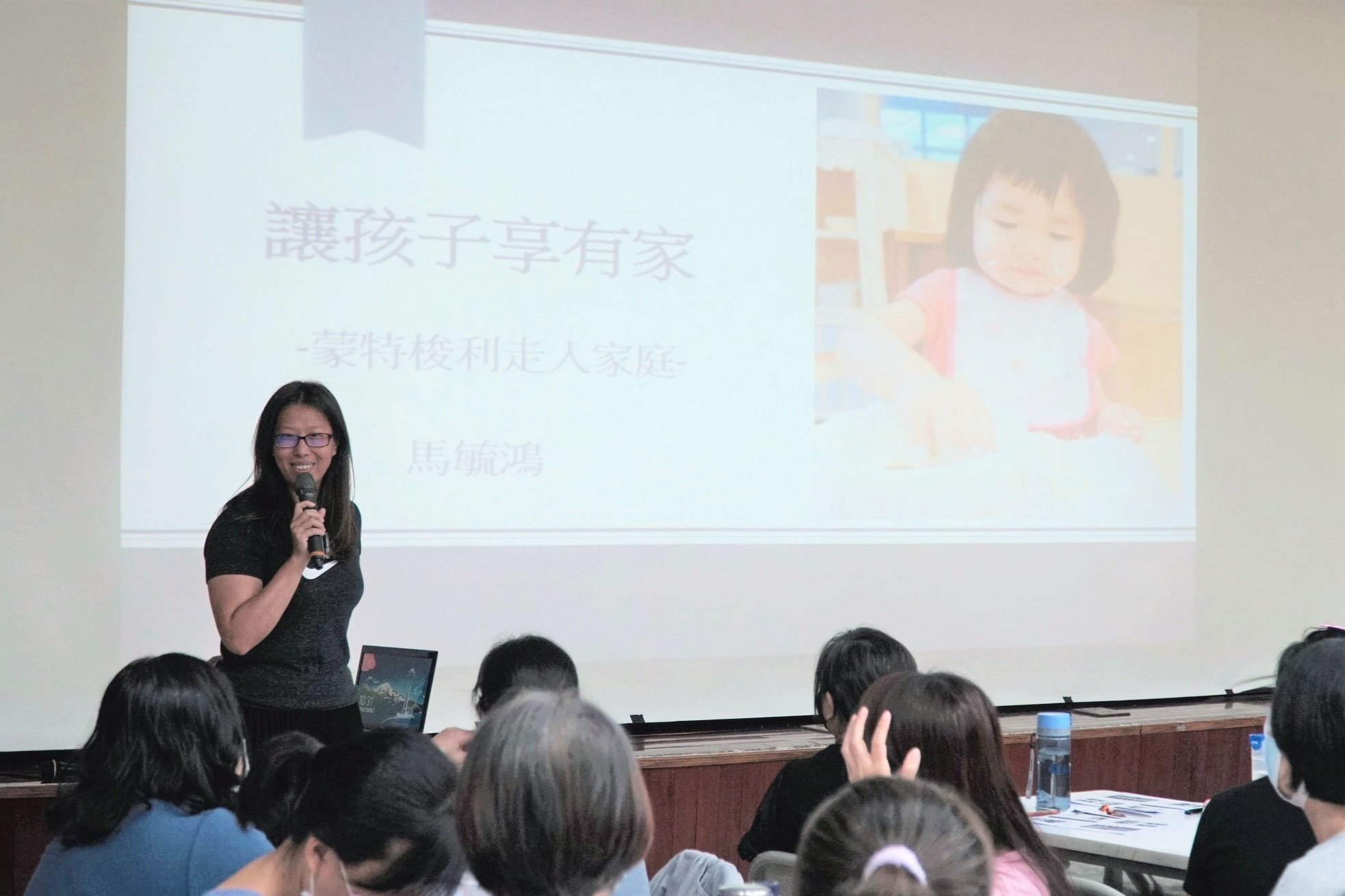
Ms. Ma fills multiple roles herself, making her especially attuned to the trilateral relationship between teachers, parents, and schools. She continues to take part in various forms of promotional activities as a means to helping more people to better understand how best to support children’s development.
In the educational arena, Ms. Ma has found that there are two types of parents who pose challenges for schools: one is what the media calls "helicopter parents"—mothers and fathers who hover over their children, solving all of their problems; and, the other type simply hands over all responsibility for educating their children to schools and teachers.
Meals and snacks offer an example of how problems might play out. The former parent-type implores teachers, "My son doesn’t like celery; please don’t include it in his meals," whereas the latter says, "My daughter hates eggplant; please find a way to make her eat it!"
Ms. Ma understands these parent types well and has her own ingenious way of dealing with them. “As long as you grasp that all-important yet invisible thread, then you’ll be okay,” she says.
What is that thread? "The most important thing in education is helping children become themselves!" She notes that difficulties children encounter in a Montessori classroom can range from minor annoyances—a too hot or too cold classroom or picky eating—to major challenges, such as trouble with academic learning or interpersonal conflicts.
All are good learning opportunities, so parents should avoid over-shielding their children and trying to solve all of their problems for them. Instead, step back and wait.
Be with them, but let them deal with the issues they’re facing. Children will learn from experience and gain self-confidence in the process. To allow children to become themselves, first, “parents and teachers must become partners in education.”
Take picky eating, for example. When a child is a fussy eater, parents can tell the teacher, "My son is a finicky eater. How can we solve this problem together?"
Never leave the responsibility of educating children to teachers; rather, form an educational alliance to help children become themselves by working together from different angles. That's what "home-school educational partnership" really means!
Ms. Ma suggests that no matter how busy parents may be, they should take the initiative in communicating with teachers.
Before a child is six years old, one-to-one conversations with the teacher every three months are recommended; after the age six, once every semester is sufficient.
Parents and teachers observe children from different perspectives – parents see only the individual child, while the teacher sees how the child interacts in a group setting.
Whether it be interpersonal problems or academic issues, as long as parents and teachers cooperate, they can bring their different points of view together and create the most conducive environment for their child’s growth.
To build successful "home-school partnerships," parents must also learn and grow along the way; only then can they truly accompany their children at each stage of the journey to self-discovery.
Trust your child and know when to let go
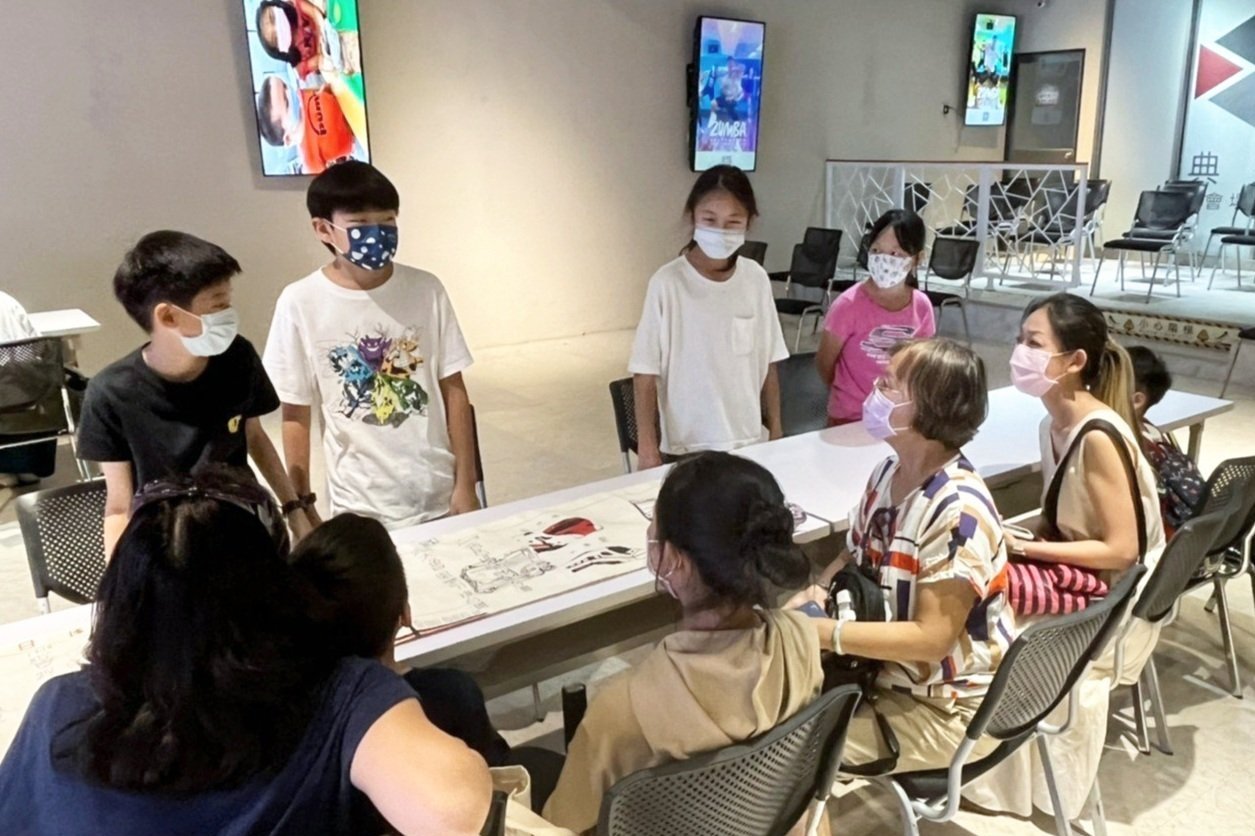
To create successful "home-school partnerships," parents need to learn and grow as well, forming partnerships with the school so that they can bring together two different perspectives as they jointly accompany the children in discovering who they are at various stages of life.
Ms. Ma also shared her son’s feelings about leaving home to attend a boarding Montessori middle school. Her son had always been very close to her, so living away from home turned into his first big challenge.
As a mother and a Montessori educator, Ms. Ma knows that children and teachers need time to adjust. Unexpectedly, after her son had finally assimilated into the community, he came home one day and told his mother about a physical fight he'd gotten into with a classmate. She didn't immediately rush to her son’s teacher seeking blame, nor did she scold her son.
Instead, to understand what happened, she wrote a letter to inform school officials of the children’s fight in the dormitory and reminded the teachers whether they feel they should communicate with the adolescents and resolve the issue together.
Her reaction was due, in part, to the trust she has for Montessori middle schools, but it also derived from her awareness that when issues like interpersonal conflicts or low motivation in learning come up, children observe how adults deal with those problems.
Because of this, children are likely to adopt a similar approach in the future. Parents should realize that whatever happens can be an opportunity for learning—both for parents and children. "In preparing children for the future, parents’ trust is essential!"
Ms. Ma shares her experience as a mother, a teacher, and an educator: "Trust in children can help them become more mature and self-supporting. This trust must be deeply rooted in parents’ hearts so that they can let go of their child’s at the most appropriate time.”
Even more consequential according to Ms. Ma is how “children’s lives are their own. Ultimately, they have to walk their own paths, so, what we can do is help them become independent contributors to society. It’s only when parents can clearly understand this can they truly let go.”
Written by Shu-Mei Weng
Images provided by Utopia Montessori School
Translators: Robert Fox, Jen Hsu/Graduate Institute of Translation and Interpretation, NTNU
How an Unconventional Learner Inspires Passion for Learning
Interview with Hsing-Cheng Fu, Rural Caring Center of Fu Jen Catholic University
Hsing-Cheng Fu was never a particularly studious child. After leaving the regular education system in high school, he entered a technical college. At that time, he never thought that education would be his calling, his life’s work, and that he would one day become a dedicated and enthusiastic educator.
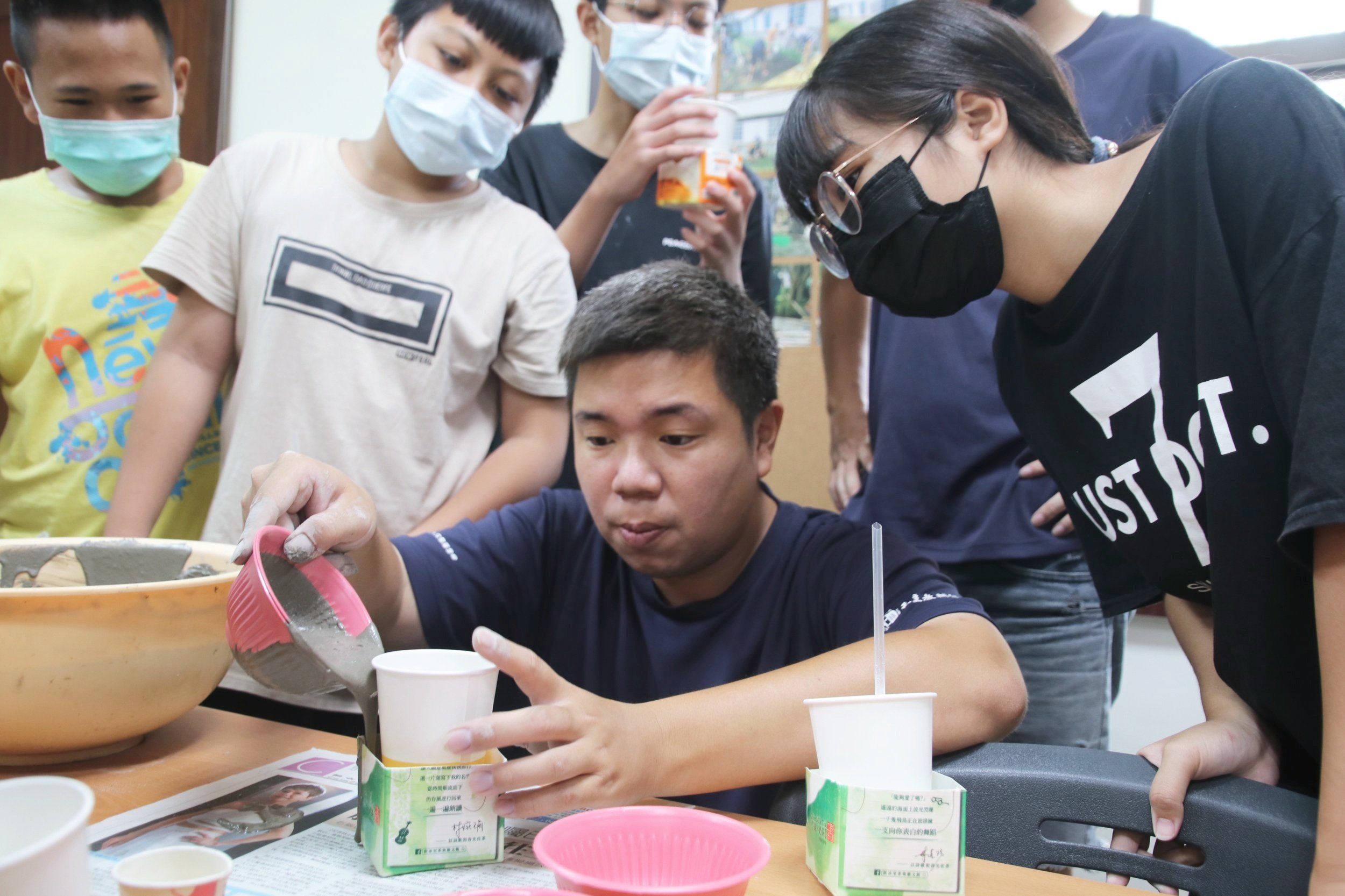
Hsing-Cheng Fu feels that he owes it all to the teachers who believed in him and provided him attention and support. This is what motivates him to want to help others, to nurture their growth, and to work as an educator.
Hsing-Cheng may appear to be an ordinary college student, but he has worked in education counseling for over 10 years at the Rural Caring Center of Fu Jen Catholic University.
In addition to regularly assisting Fu Jen Catholic University and Mercy Home in promoting services for remote communities through online after-school programs, Hsing-Cheng also visits the children personally during summer and winter breaks to guide them on their learning journey.
Looking back on his own past, Hsing-Cheng feels that he owes it all to the teachers who believed in him and provided him attention and support. This is what motivates him to want to help others, to nurture their growth, and to work as an educator.
“I believe, rather than changing the environment, it is better to help the child to better face the environment that they’re in.” It is his empathy that drives him to better the lives of children living in remote areas.
Learning is letting children make mistakes
When conducting after-school programs for children in remote areas, Hsing-Cheng realized that in many cases, perhaps due to the child’s family dysfunction or lack of learning resources growing up, it takes time for both the educator and student to communicate and adjust to each other’s value system.
He believes that letting children make mistakes is also part of learning. Traditional educators tend to unilaterally "teach" or "remind" children orally, but he saw a different approach in Montessori philosophy.
Hsing-Cheng notices that “when children make mistakes, we should encourage them to understand the process, systematically guide children to break down steps, observe, and accompany them from the sidelines. In the end, the teacher has to learn to let go and return to their role as a guide.”
In 2021, Hsing-Cheng joined the Montessori Social Impact Talent Development Program and underwent AMI Montessori teacher training. Afterwards, by applying his training and past experiences, he developed a program and cultivated college students to participate in local community services.
Montessori philosophy highlights that the natural environment supports students’ development; therefore, “caring for the environment” is an important part of Montessori education.
For example, teaching an adolescent mop a floor is more than just telling them to do the chore. The teacher should guide the adolescents, show them how to hold a mop, how much water to use, how to put away the tools and in what order.
Each step is dissected so that the adolescent is motivated to use their own acquired skills to complete the task. How does a teacher help fulfill a child’s need for independence?
Hsing-Cheng confidently replies, "The Montessori teaching concept of 'learning by doing' and 'doing by learning' is not only suitable for children aged 6-12, but as long as we establish systematic learning in their minds, it will also have an unconscious influence on their future careers and lives after entering society!"
After undergoing the intensive curriculum of AMI Montessori teacher training, Hsing-Cheng realized that the difficulty for many educators is that there is no prescribed formula in applying Montessori theories, but that is exactly what makes the Montessori approach so interesting!
He embraces the ideal that as each child explores within a Montessori environment, they can find the path, which best suits their own learning.
This new outlook toward teaching inspired him to return to the remote areas of his childhood and to inspire youths and college students to join his efforts to teach in remote areas.
Each conversation is a lifeline

Hsing-Cheng Fu believes that as each child explores within a Montessori environment, they can find the path, which best suits their own learning.
Working to assist children in remote areas comes with a host of challenges, as many students come from troubled families or are unable or unwilling to attend school.
Those, who work in educational counseling, are mostly still enrolled in or are new graduates from college in urban areas. The difference between their backgrounds and that of the children they are seeking to help forms a nearly insurmountable obstacle.
If this gap is not bridged, the result is that the children feel alienated, and the counselors are left feeling frustrated. Hsing-Cheng’s advice to counselors in this dilemma is to take a step back and maintain a degree of flexibility in the situation rather than proceeding by the book.
He prefers to focus on the child and guide them through some kind of hands-on activity, whether that be gardening, woodwork, or doing math calculations, to uncover their intrinsic motivation for learning.
This allows both the student and educator to give and receive feedback, learn from one another, and build their confidence.
Hsing-Cheng’s participation in sponsored teacher training and his return to Taiwan to integrate Montessori principles with educational counseling for children in remote areas has inspired him to reset, reflect, and push forward on his quest.
He believes that with each guidance session, comes the opportunity to restore a child’s passion in learning, which can prevent them from giving up on themselves or to decide to turn to a life of organized crime.
In addition to working through existing agencies, Hsing-Cheng plans to establish an experimental education group to make Montessori affordable for everyone. It is this enthusiasm and dedication that has brought him to where he is today and empowers him to continue on his quest in the future.
Written by Angelina Chan
Images provided by Hsing-Cheng Fu
Translators: Robert Fox, Jen Hsu/Graduate Institute of Translation and Interpretation, NTNU
Zhong Keng Elementary School: Emerging Metamorphosis (2-2)

The transformed mixed-age classroom for ages 6-9 is a relaxed environment, where children can freely focus on becoming the primary agents of their own learning.
Placing teachers in their most effective role
Though parents were supportive, Ms. Chang knew a bigger challenge lies ahead: teachers would need to receive Montessori teacher training or at least understand Montessori concepts. How to go about building a consensus amongst the teaching staff?
"First of all, read the books!" Having benefited from Montessori literature herself, the principal encouraged Zhong Keng teachers to read The Secret of Childhood. The faculty formed a reading club that helped provide a step-by-step guide into the world of Montessori.
However, reading in and of itself was not enough. During the 2021 winter break, Ms. Chang invited the teaching staff to Taipei Montessori International School (TMIS), where they observed a Montessori classroom for the first time.
The teachers were astonished: "Who knew the classroom space could be used like this!” one exclaimed. "So, this is how mixed-age education works!" said another.
Countless small shocks rippled through the faculty, generating a beautiful vision of an educational landscape that proved to be a powerful inspiration for Zhong Keng’s transformation into a Montessori school.
Ideally, all the teachers would undergo Montessori teacher training. In reality, however, some teachers want to wait and watch at the sideline; some want to learn by doing, while others devoted themselves wholeheartedly to the method. Giving teachers free rein to express their values proved to be a test of the principal’s wisdom.
Classroom reorganization was the school’s first priority. Zhong Keng followed their reviewed and approved experimental education plan. For the first two years, the school maintained mixed-age classes for the lower, middle, and upper grades, while preparing two Montessori classrooms for the 2022-2023 year (one classroom for ages 6-9 and another for ages 10-12).
Teachers were the next step. Professional teachers who had received Montessori teacher training serve as primary instructors; teachers learning on the job act as assistant teachers; and those who have received only basic training make up the administrative team, who support and assist classroom instruction.
Each of these three groups has its own strengths. Ms. Chang intends for assistant teachers to continue to learn and grow and one day become primary instructors. "In its Jena Plan, Zhong Keng had two different worlds in one classroom. This is no longer the case!" says Ms. Chang with a smile.
Today, teachers teaching in the same classroom have also changed how they interact thanks to the Montessori educational concept. They’re more willing to reflect on their actions and have become more conscientious toward each other.
Ms. Chang couldn’t be more pleased: "The atmosphere on campus has become even more harmonious!”
If the environment isn’t ready, keep making adjustments
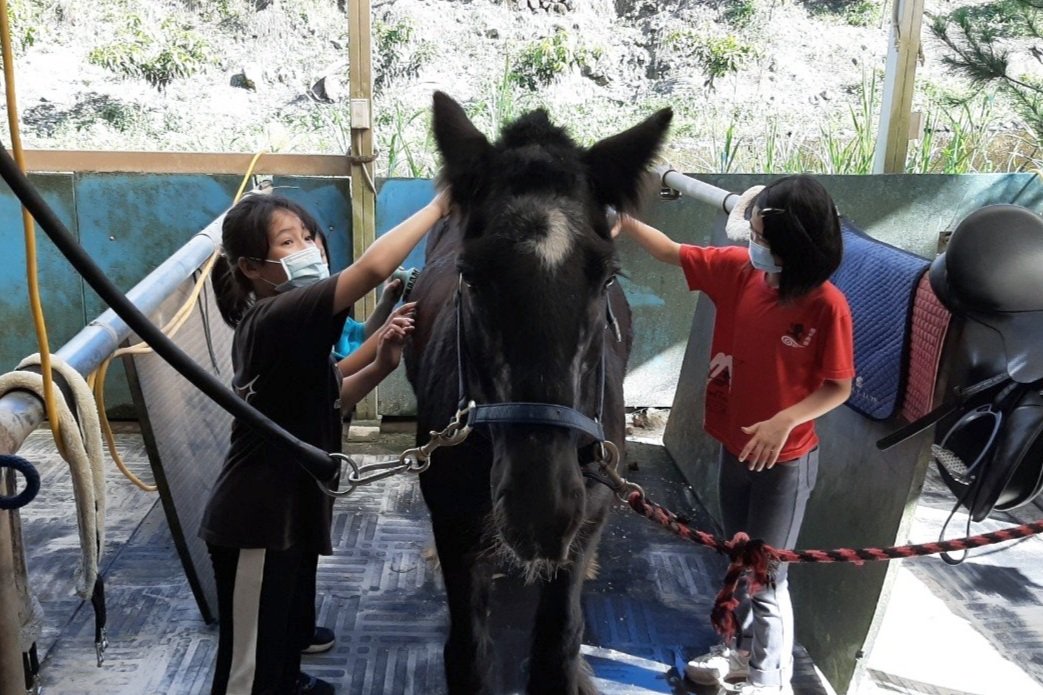
The campus is near an equestrian school, making the "equine studies" class a unique feature of Zhong Keng's practical life education.
Montessori education emphasizes a "prepared environment.” That’s a tall order for Zhong Keng Elementary School, which is located in a remote area, has limited resources, and has experienced the devastation of the 921 Earthquake in 1999.
For example, when the school was rebuilt after the disaster, planners based the size of classrooms on small-sized rural schools. The resulting classrooms were comparatively small for Montessori teaching and could not be easily expanded. Other than redesignating the auditorium as an open classroom space, learning space expanded outdoors.
In the end, the original facility, which would be too crowded to house mixed-age students, was fully utilized - every available corner inside and outside the confines of the classroom are all part of the learning environment.
What’s more, there’s an equestrian school nearby. One of the “work” for these “cosmic children” is to learn about horse-related knowledge, such as horse health and diet, how to curry a horse’s coat, how to clean stables, precautions for riding and leading a horse, horse mathematics, and even the relationship between horses and human history and culture.
Teaching from the perspective of cosmic education expands children's learning and broadens their horizons. The "equine studies” class has unexpectedly become a unique feature of Zhong Keng’s life education.
For Accessible Montessori education to succeed, relying solely on the strength of the school itself is not enough. With the support of a dedicated group of parents and a teaching team unafraid of challenges and committed to continuous learning, Montessori can be implemented step by step, which in the case of Zhong Keng, has allowed Montessori education philosophy to take root.
"No environment can ever be fully prepared. There are always constant adjustments and adaptations.” Zhong Keng’s transformation has just begun, says Ms. Chang.
She hopes that after the process has been completed, Zhong Keng Elementary School will truly become "a school that "connects all things with love," where teachers and students will inwardly explore how to become warm and loving human beings!
Written by Yu-Hsiu Su
Images provided by Zhong Keng Elementary School
Translators: Robert Fox, Jen Hsu/Graduate Institute of Translation and Interpretation, NTNU
Zhong Keng Elementary School: Emerging Metamorphosis (2-1)
interview with Ching-Wen Chang, Principal of Zhong Keng Elementary School, Taichung

I walked into Zhong Keng Elementary School in Taichung City’s Heping District on a warm winter afternoon. There were no sounds of students reciting lessons on the quiet campus—all that could be heard was the wind blowing on treetops.
In such stillness, it wouldn’t be unusual for one to think the students are sleeping. Peering through a clean and clear window pane on the first floor, I saw children in the middle and lower grades concentrating on completing the tasks at hand.
They were orderly and relaxed, an utterly captivating sight of one of the nation’s first public Montessori experimental elementary schools.
The decision from Jena Plan to Montessori
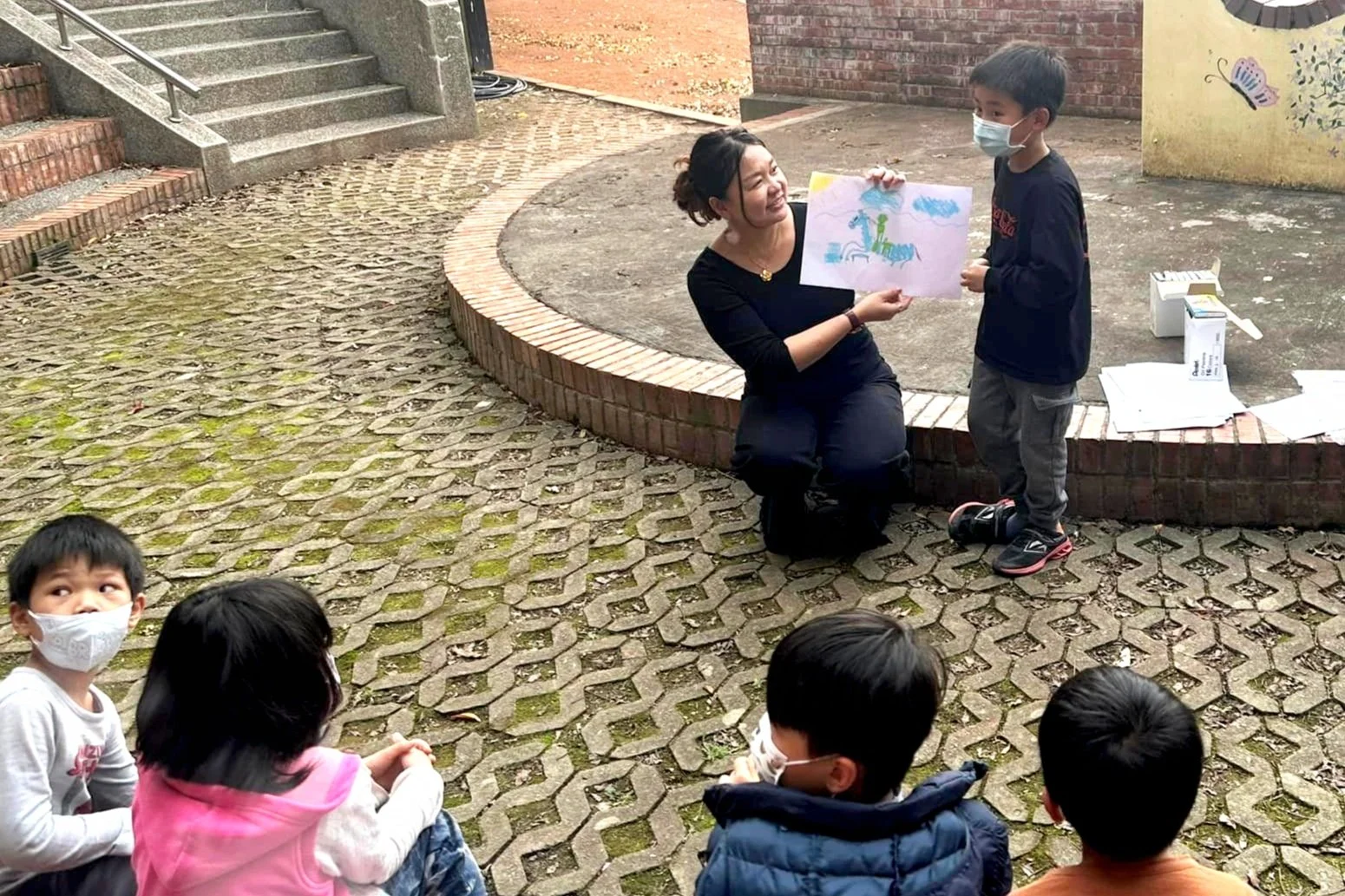
Inspired by the beauty of the Montessori concept, principal Ching-Wen Chang says she hopes that teachers will no longer have to walk the road of educational transformation alone thanks to the professional development and support provided by TMEC’s Accessible Montessori Program.
Before switching to Montessori in 2020, Zhong Keng was already an experimental elementary school, which followed the Jena Plan educational system and adopted mixed-age teaching.
However, it was relatively difficult to grasp Jena Plan’s core spirit. Most instructors had to rely on personal experience alone to resolve challenges of teaching students at varying levels.
"We didn’t completely understand the Jena concept. We were mixing ages just for the sake of mixing ages,” said Zhong Keng principal Ching-Wen Chang, who took office in 2019.
Seeing the teachers’ and students’ predicament, Ms. Chang wondered whether change was possible. Her internal voices must have been heard, for an opportunity soon appeared.
Proactive and conscientious, Ms. Chang was studying Adler's positive psychology when the school was about to apply for a continuation plan that required them to delineate their education philosophy.
Seeking advice, she consequently spoke with Professor Tung-Lian Cheng of National Chengchi University.
After reading Montessori Today, a book the professor had recommended, she was moved by the Montessori approach to education. "This beautiful concept is worth trying," she said.
Never one to sit idle, the principal immediately packed her bags and travelled with a colleague to Taipei, paying their own way, to attend “Montessori Education in Public Schools,” an experiential camp hosted jointly by the Y2 Foundation for Future Education and the National Chengchi University—Taiwan Montessori Education Center (TMEC) in August 2020.
They also attended “Accessible Montessori Education Program,” a seminar that explained its application process. Ms. Chang continued to hold discussions with teachers, parents, and scholars, working hard on weekends and holidays to draw up a plan. The school passed the preliminary review in September of the same year.
Empowering parents to be strategic partners in change

The school’s parent association and volunteer group played a key role in bridging Zhong Keng’s smooth transition to Montessori education.
The law of attraction worked its magic at Zhong Keng. The "Accessible Montessori Education Program" cultivated a new direction for the school. No more would the teachers vacillate between traditional and experimental methods.
More importantly, TMEC provided the teachers with professional training and support so they would no longer feel isolated or hesitant in the practice of their profession.
Change takes a commitment to teamwork and planning. Despite Ms. Chang’s enthusiasm, transitioning to Montessori education was no simple matter. It meant re-empowering teachers and spending more time training them.
Moreover, teachers also needed to change their attitudes and values. They also need to effectively communicate with parents; none of these changes came easy.
How was all this to be done? After much thought, Ms. Chang approached it from two angles. First, she sought out parents supportive of the concept, with whom she shared Montessori’s educational philosophy.
She also explained the changes it might bring to the children and what adjustments teachers would have to make. After obtaining the parents' association’s approval, a LINE group was formed, and the association president and other members assisted the school in communicating with all parents in answering their questions.
The parent group's efforts smoothed the transition from Jena Plan to Montessori. "We helped the school provide answers to some preliminary questions, which allowed teachers to focus themselves on improving their teaching methods,” said Guan-Yin Liu, the vice president of the parents’ association.
How would the school assure parents? Ms. Chang believes that: “Children’s changing behaviors is the best way to convince parents.” When children no longer say profanity, run out of class for no reason, and proactively asks questions and tries to find answers when they go home from school…all these seemingly minor changes gradually convince parents to feel at ease to leave their children’s education to the teachers.
Not only did new students enroll in the school, there are parents, who drive 40km daily to send their child to Zhong Keng. Currently, the lower elementary class is at full capacity of 30 students, which is an all time high for the school.
Moreover, Zhong Keng’s Facebook posts give parents peeks into their children’s school lives. Ms. Chang believes in the concept that "the best ideas need to be disseminated."
Using Facebook to document and share the results of Montessori education is an open and transparent way to relieve any concerns parents might have.
Parents' True Confessions
The importance of Zhong Keng parents for the school’s successful transition to a Montessori educational program cannot be overstated. Countless parental concerns needed to be discussed: "Why do you want to transform the school? What will happen after the transition to Montessori? How will it impact will the children?"
Zhong Keng Experimental Primary School’s parents' association and the volunteer group were crucial for bridging the gap between the parents’ concerns and the school’s objectives, reducing considerably the time administrators would have had to spend answering parents' questions individually.
Parents’ association head Sheng-Hung Liao is a Zhong Keng local opposed to the idea of rote learning. He bases this attitude on trust and letting go. He notes how traditional learning relied on repetition and drilling, whereas Montessori education uses cross-subject projects for learning.
More importantly, Montessori schools empower children to find solutions on their own. “When we don’t have an answer to our children’s questions, they will go to their teachers for help or learn to solve them on their own. Parents need to be patient and let it play out,” Liao says and then suggests with a smile that we also need to remind grandparents from time to time to be hands off on academic learning but keep their eyes on their grandchildren’s behavior.
Zhong Keng Parents’ association’s vice president Guan-Yin Liu, whose children were recipients of Waldorf kindergarten education, notes: "In experimental education, parents must be willing to give up drilling and repetition and let their children educate them."
Because the Montessori teacher's materials and methodologies are entirely different from how the parents learned in school, mothers and fathers become very anxious when faced with this new approach. Guan-Yin Liu believes in the need for them “to have trust in both the school and the teacher."
Even though the initial transition from Jena Plan to Montessori was a bit chaotic, Principal Chang, nevertheless, still set aside considerable time and is dedicated to communicate the process to the parents: “They just want to see the changes Montessori education can bring their children and hope that experimental education is not an experiment on their children.”
Parents’ association’s vice-president Tsui-Ying Hung stresses that parents need to have faith in the school's professionalism, even if parents sometimes do not understand how the curriculum is organized.
For instance, a first-grade material was covered one week, but switched to a second-grade material the following week. It is only after seeing how their children became more immersed in the material did parents realize the teacher’s intent. The parent group ultimately decided it be best to "go with the flow" and refrain from interfering with the methods or progress of teaching.
>> Zhong Keng Elementary School: Emerging Metamorphosis (2-2)
Written by Yu-Hsiu Su
Images provided by Zhong Keng Elementary School
Translators: Robert Fox, Jen Hsu/Graduate Institute of Translation and Interpretation, NTNU
KNOCK-KNOCK, OPEN THE MYSTERIOUS DOOR OF A MONTESSORI MIDDLE SCHOOL (2-2)
Knock-Knock, Open the Mysterious Door of A Montessori Middle School (2-1)
The Birth of a Montessori School
Experimental Education as a Self-Guided Journey of Exploration
Interview with Tim Chen, Chief Organizer of Taiwan Homeschool Advocates
What kind of education method can encourage children to explore their world freely? In 2003, Tim Chen and his wife Dorota Chen-Wernik had seen enough of Taiwan’s spoon-feeding education system and decided to take their 6-year-old daughter Zosia on a path of self-study, allowing her to have autonomy over her own learning process and to engage with her Polish culture.
Ever since then, Tim Chen, has been called “Taiwan’s Godfather of Homeschooling,”as he has been an ardent advocate of home schooling.
He shares his family’s experiences and is instrumental in promoting the passing of the Three Laws on Experimental Education. His three children were all home-schooled, and their experiences have served as a guiding light for families interested in self-directed education.

Tim Chen, Chief Organizer of Taiwan Homeschool Advocates.
What is experimental education? Tim cleverly likens home schooling or experimental education to a self-guided tour. The child can plan out their journey based on their own interests and pace.
While the child may veer off the path or encounter obstacles, the detours may lead to unexpected scenery; eventually, the child will find their own way.
In contrast, traditional education is like traveling with a tour group. The teacher acts as a tour guide, leading students on a predetermined itinerary. The students are not allowed to wander off or linger for too long on something that has piqued their interest.
In the end, the students are not encouraged to think for themselves, only to follow the teacher’s instruction and plans, eventually resulting in students losing their own proactiveness.
Parents as learners are the key to successful experimental education
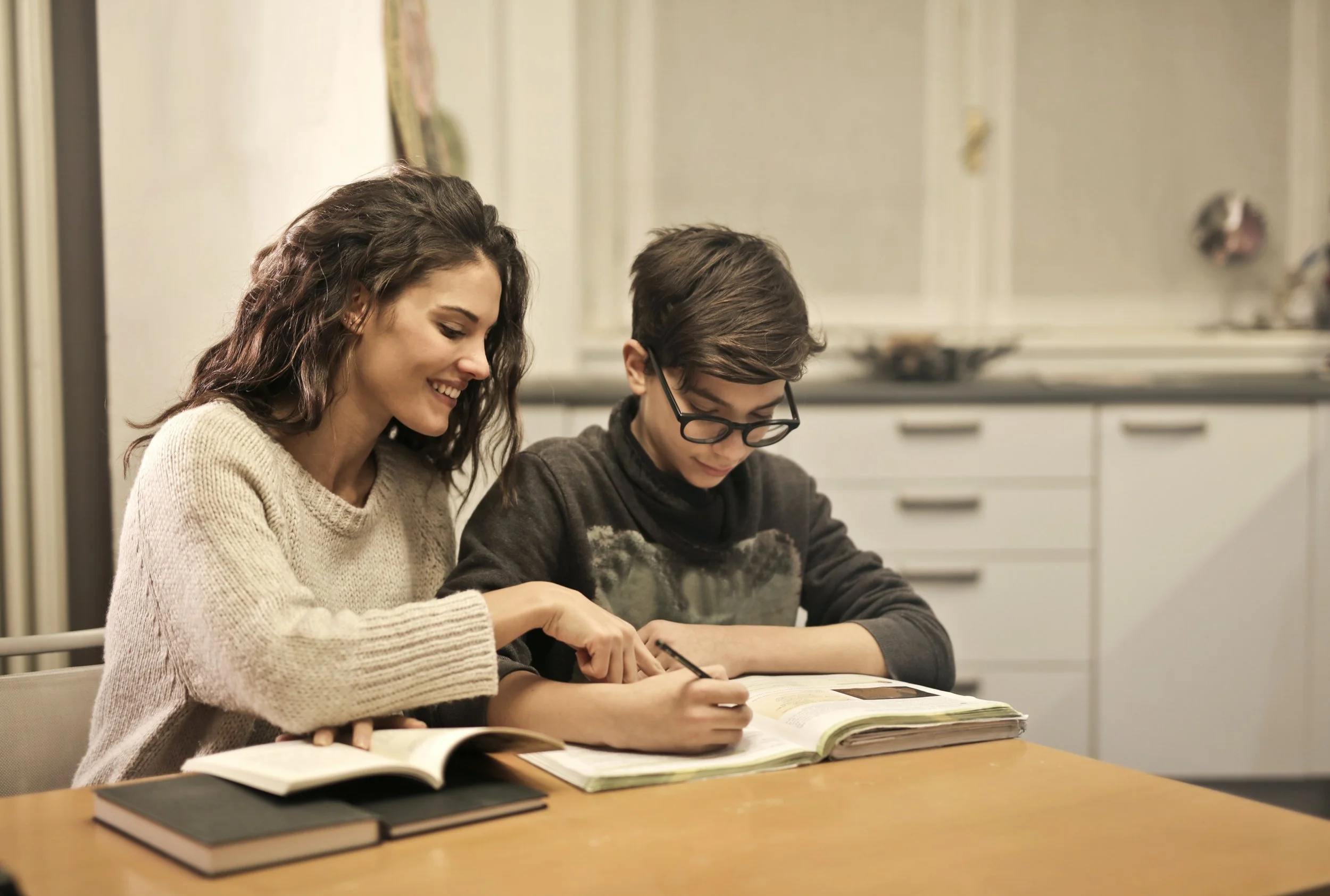
photo by pexels
In the past, only a small number of children are home schooled, and they were often unfairly labeled as “problem children“.
Now times have changed, and more parents are taking their children on a self-guided journey of learning and exploring alternative paths. In Taipei City alone, more than 1,000 children and their families have chosen to engage in home schooling each year.
Engaging in home schooling or experimental education is not a path to be taken lightly. It may not always be smooth sailing to freedom, and the responsibility of education does not rest on the teacher. Instead, parents will face a transition period going from traditional education to experimental education, during which they need to commit more time to their children.
Tim suggests that both parents and children need to set their sights on bigger objectives and discard traditional education system benchmarks typically used in measuring progress, such as grades, class ranking, and blind obedience to authority.
Parents also need to become learners, exercising patience and devoting more time to discover their children’s strengths and rethinking the roles they will play in the world of the future.
In Tim’s experience, it takes on average three to six months for parents and children to fully adjust and to regain their motivation for self-learning. Slowly, parents will begin to see the transformative effects of home schooling on their child.
True experimental education has not yet begun

photo by pexels
What kind of talent does the future need? No one can say for certain. All we know is that students must have the ability to face the unknown and the motivation to explore it.
It is exactly for this purpose that educational reform in recent years have sought to undo the spoon-fed or cramming feature of the current school system.
However, that is easier said than done. Tim, who was a member on the advisory committee for education reform, believes that experimental education can lead the way and offer a tangible example of what traditional school systems can do. He points out,
“Experimental education or self-study can nudge traditional education into changing for the better. By showing them that change is not as hard as it seems or that overcoming obstacles can lead to interesting results, we are offering the existing education system an opportunity to transform itself!”
Tim has even proclaimed that “true experimental education has not yet begun.” Current curriculum design reflects our past experiences; to prepare for the future, we need to think outside the existing framework and adapt to the changing world more quickly and flexibly.
“Education should be constantly evolving as we pursue shifting objectives. We cannot afford to rest on the laurels of past education reforms.”
In Tim’s opinion, the framework for future public education should shift from vertical to horizontal integration. Furthermore, existing education institutions should be deconstructed. Tim believes that “the education authority should be supervisory and not the provider of education.”
Perhaps, communities, villages, and tribes can adopt the school board system that is so popular abroad, so as to develop suitable education styles that reflect localized features.
Technology can be utilized to integrate resources horizontally so that every child can be supported and guided on their learning journey in their own way, with no child left behind.
Promoting Montessori to provide more humanistic care and support
The Montessori approach is not just tailored for childhood education, it can support individual needs and lifestyles for people aged 0 to 100! Montessori methods for aging and dementia also empowers elders to feel supported and to live with dignity.
Professor Chou is planning to incorporate Montessori methods into the curriculum of the School of Nursing as well as the design of the dementia ward at Taipei Medical University Hospital. To her, this online workshop marks an important first step for promoting public awareness of Montessori concepts.
“Students can apply these principles in their professional fields. In the future, when the number of professionals immersed in the Montessori method reaches critical mass, we can build a dedicated environment, where application of Montessori principles are possible.”
Professor Chou also offers a gentle reminder to keep in mind the cultural differences between the East and the West when applying Montessori principles, “In our culture, the elders expect to be cared for by the younger generation, so we need to consider how best to introduce the Montessori method in aged care and help maintain their independence, while ensuring that they feel sufficiently cared for and respected.”
Text: Yi-Yun Li
Translator: Jen Hsu / Graduate Institute of Translation and Interpretation, NTNU
This article is an excerpt from Y2 2021 Annual Report.
Montessori Education Shines a Spotlight on Dementia Patient
Interview with Professor Kuei-Ru Chou, Taipei Medical University
Imagine that one day, you can’t remember your way home, you no longer recognize the faces of your family, and even feeding yourself becomes an insurmountable challenge. Imagine living in such a terrifying and miserable situation.
In Taiwan, 1 in 12 seniors above the age of 65 suffers from dementia. According to the World Alzheimer Report 2019 by Alzheimer’s Disease International (ADI), more than 50 million people live with dementia globally, with someone developing dementia every three seconds. Figures are forecasted to increase to 152 million by 2050.

(Photo by Dominik Lange on Unsplash)
In light of the pressing need to address dementia, the Montessori approach brings new hope for the care of the elderly and dementia patients. Through a prepared environment, we can compensate for their cognitive or physical impairment and encourage them to live a happy and fulfilled life by stimulating their remaining faculties, helping them to maintain their independence, and in turn, finding life fulfillment and joy.
Academia and medicine cooperate to explore Montessori applications in dementia care

Images provided by: Kuei-Ru Chou
Through Y2’s introduction and networking, Taipei Medical University Professor Kuei-Ru Chou began their collaboration with AMI, hosting the Montessori for Dementia Care Online Workshop to promote the use of Montessori methods to care for elders and those suffering with dementia.
Anne Kelly, the keynote speaker, is a registered nurse from Australia with more than 40 years of experience in nursing and aged care. She has been using the Montessori approach for elders with dementia for over 13 years and is the Head of Montessori for Dementia and Aging at AMI.
The online workshop took place over two days and attracted more than 400 participants globally. Everyone was eager to learn how to apply Montessori education methods to the care of dementia patients. Professor Kuei-Ru Chou of the School of Nursing, Taipei Medical University, shared her thoughts:
“Dementia is a very important subject in geriatric psychiatry. Traditional aged care puts us on the sidelines, always observing but never able to do anything for the patient. The Montessori method supplements what is lacking in traditional methods of professional nursing. It reminds us to see the individual obscured by the symptoms of dementia, find out what they are good at, and enable them to be the best that they can be.”
Seeing the person and not just the disease

photo by Matthias Zomer on Pexels
Dr. Maria Montessori once said, “The more you do for me, the more you take away from me.” This sentiment also applies to the care and support for those living with dementia.
This worldview helps shift the focus of professional nurses and family members from the various symptoms of dementia back to the person. Professor Chou explains,
“We need to focus on the individual’s desires, habits, and needs and how they became the person they are today. How does the individual feel? What are they capable of? What activities make them feel happy and confident? These questions all get to the heart of who an individual is.”
We should view persons with dementia as people who are still capable of learning. This shift in focus means that, in the event when somebody is losing the ability to feed themselves, we don’t immediately jump to the conclusion that they need to be spoon fed.
Instead, we should design related activities to maintain their fine motor skills to allow them to be able to continue to feed themselves for as long as possible.
Professor Chou uses “eating dumplings” as an example: “Eating dumplings can be divided into many smaller tasks, such as choosing the type of dumplings, meal preparation, setting up utensils, plating the dumplings, and the act of eating.
These are all tasks that our elders can participate in and accomplish. These activities not only slow the progression of dementia, but also allow our elders to live with dignity.”
Promoting Montessori to provide more humanistic care and support
The Montessori approach is not just tailored for childhood education, it can support individual needs and lifestyles for people aged 0 to 100! Montessori methods for aging and dementia also empowers elders to feel supported and to live with dignity.
Professor Chou is planning to incorporate Montessori methods into the curriculum of the School of Nursing as well as the design of the dementia ward at Taipei Medical University Hospital. To her, this online workshop marks an important first step for promoting public awareness of Montessori concepts.
“Students can apply these principles in their professional fields. In the future, when the number of professionals immersed in the Montessori method reaches critical mass, we can build a dedicated environment, where application of Montessori principles are possible.”
Professor Chou also offers a gentle reminder to keep in mind the cultural differences between the East and the West when applying Montessori principles, “In our culture, the elders expect to be cared for by the younger generation, so we need to consider how best to introduce the Montessori method in aged care and help maintain their independence, while ensuring that they feel sufficiently cared for and respected.”
Text: Shu-Mei Weng
Translator: Jen Hsu / Graduate Institute of Translation and Interpretation, NTNU
Why It All Started: Accessible Montessori
With an assortment of educational tools and pedagogies at their disposal, how do educators and parents make the best choice for children?

(Photo by CDC on Unsplash)
The Montessori method stands out from other education approaches in that it provides a prepared environment for children based on their developmental needs, allowing children to learn at their own pace, both in terms of pursuing knowledge and developing empathy and interpersonal skills.
This approach echoes the 2019 objectives set forth in the Curriculum Guidelines of the 12-year compulsory education system: self-motivation, interaction, and common good.
The Montessori mixed-age classrooms, which have been implemented for over 100 years, may be just the solution for Taiwan’s current education crisis.
While appreciating Montessori’s ability to ignite each person’s innate qualities, Y2 co-founders Andy and Cynthia are inspired to start Y2 after witnessing the transformation of their own children in Montessori schools.
They first established the teacher scholarship program to provide financial support for teachers to undergo Montessori training abroad and to apply what they have learned in Taiwan’s educational environment.
However, we strongly believe that quality education should be accessible to more people, and out of this desire, the program Montessori Education in Public Schools began in 2018.
The aim is to promote Accessible Montessori through public schools, optimizing school resources to provide Montessori education to more children, and assist them in their learning and development.

During the three years of this program, Y2 has explored various methods such as supporting public schools to transition to the Montessori method, researching public policies, and providing assistance in implementation.
We have learned that, only with the coordinated efforts of the public sector, schools, and families working toward a common goal, can we provide the ideal education environment in which students can learn with peace of mind. Each of the three elements is indispensable, as each has its own share of obstacles to confront and overcome.
The first group of Montessori experimental schools will be selected in 2021 for Y2’s Public School Transition Project. This is but the first of many steps.
We are well aware that even greater challenge lies ahead—the next phase of entering the classroom. As we move forward, we grapple with issues that have confronted us since the very beginning.
Should schools gradually adopt Montessori concepts, or transition into a Montessori environment all at once? How to develop a Montessori program that harmoniously blends into public schools in Taiwan, while preserving the unique culture of each place? How do we define and represent the essence of Montessori?
These are a few of the many unpredictable unknowns we face, as we embark on this brave new adventure. They will continue to be challenges for us to always ponder and explore.
Going back to Y2’s mission, the goal of making Montessori more accessible still remains the focus of our work. In our effort to provide diverse education choice for Taiwan’s children and parents, we do hope to hear from you and to take your ideas into consideration.
Do you wish there are public Montessori elementary and middle schools?
Are you a parent or teacher worried about children’s education or simply a concerned citizen?Please share with us any suggestions, opinions, or thoughts!
Encouragements are always welcome!Reach us via email: tmec@y2edu.org
or message us at our Facebook: search @y2eduJoin us and together, we can Be the CHANGE for Future Education!
This article is an excerpt from Y2 2020 Annual Report.
Have you heard the Y2 Podcast?
Interview with Y2 podcast “Chat 2 Heal” hosts—Cynthia and Diane

Have you heard the latest Y2 Podcast? Due to the disruption of scheduled programs and inability to host in-person events during the pandemic, Y2 decided to turn the crisis into an opportunity and launched the podcast Chat2Heal in 2020.
The podcast introduces a series of topics dear to the hearts of parents and teachers and discusses them in depth. What is the podcast about? Chat 2 Heal is hosted by two mothers, Cynthia Hang, co-founder and executive director of Y2, and Diane Teng, Y2’s COO.
Together, they decided to share their personal experiences, Montessori concepts and practices, and other related issues in a podcast that speaks directly to the audience, creates a space for healing, and occasionally wanders down memory lane before motherhood.
No lecturing, just empathy and support
With over 10 years of expertise in family relationships, Diane cheerfully explains, “Our show’s premise is: we’re not here to lecture anyone.”
As a mother, she commiserates with other parents. “The process of children’s education can be very frustrating. It’s impossible to see results right away, and it’s natural for parents to doubt themselves.
We simply want to share this process with everyone. We are all doing our best, and there is no one ‘right’ way to parent.” Through candid chats about these issues, podcast listeners will discover that they aren’t alone and that many others are going through the same challenges.
In fact, the podcast creates an environment of “empathy and support.”
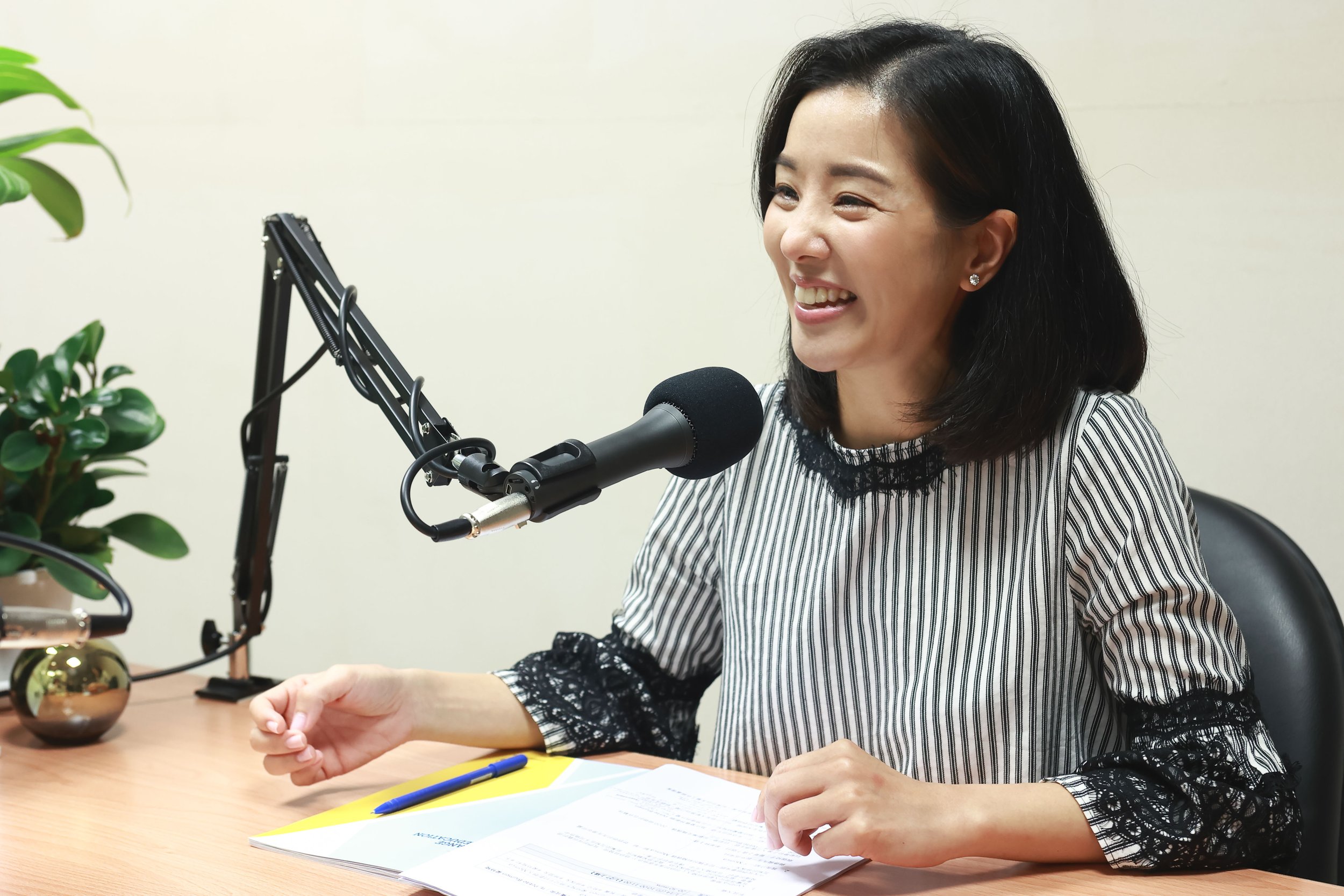
Y2 podcast “Chat 2 Heal” host Cynthia
Cynthia often communicates with educators in her capacity as the executive director of Y2; however, she hopes to reach parents and anyone in need with this podcast, which features a more sensible and practical content.
Holding an AMI Montessori 0-3 Diploma, Cynthia naturally incorporates Montessori theories and practical applications in the easy conversation with her co-host.
The podcast is full of interesting content for adults, such as fatherhood beliefs and maternal gatekeeping. Moms aren’t the only ones that can benefit from learning how to apply Montessori methods in everyday life, even singles, DINK (double income, no kids) couples, and dads have found this podcast useful!
Many listeners are shocked to learn that the Montessori method doesn’t apply only to education settings, but can be utilized in all kinds of interpersonal relationships, such as parent-child relations and marriages.
Cynthia believes that “We don’t need to wait until we’re successful and famous to start changing the world. Taking a small step for yourself or your family is already a big step for humanity. We hope that people can be less harsh and more kind to themselves.” This is the main message of the Y2 podcast.
Strive to be a better human being, not a “perfect” parent
In recording Chat2Heal, Diane and Cynthia both realized that there is no such thing as a perfect mother; even so, the parenting process made them strive to become better people.
Full-time mothers who feel devalued may find strength in growing to become better human beings. Cynthia even joked that recording the podcast is very therapeutic for herself and that she feels somewhat incomplete whenever recording takes a long break.

Y2 podcast “Chat 2 Heal” host Diane
Diane hopes to become a graceful mommy. On her Montessori journey of learning, she realized that the most important lesson is not about Montessori’s methods or concepts, but in how to view children.
She believes that what is in her heart can be observed in her actions, just as the ancient Chinese classic Great Learning states: “Inner sincerity will surely be expressed outward.” Diane adds, “Because I trust my child, I’ve learned to take things slow and live life with grace.”
“What we’re sharing is not the solution to all of life’s problems. What we offer is empathy, which empowers people to deal with issues head on. In parenting, we seek to overcome, not be overwhelmed. We need to learn to give ourselves a break, not give up on ourselves,” explains Cynthia.
Many of us only start to learn how to accept and understand ourselves and others after becoming parents. Through the podcast Chat 2 Heal, Y2 seeks to empathize with, give comfort to, and support individuals in this community.
By learning to apply Montessori principles to everyday life, we can all take steps to create a better version of ourselves.
Written by Yu-Hsiu Su, Photo credit Fu-Sheng Li
This article is an excerpt from Y2 2020 Annual Report.
The path into the unknown: Montessori teacher training
interview with Fangyun Hsu, Chief Development Officer of Y2 Foundation for Future Education
What in the world would drive Fangyun Hsu, Chief Development Officer of Y2 Foundation for Future Education, to apply for leave without pay and travel to Italy on her own dime to undergo Montessori teacher training? Having spent more than 10 years working in the arts, Fangyun recalled how she felt three years ago upon deciding to join Y2: “I asked myself, what kind of job would I be willingly do without pay? My instinctive answer was ‘education.’” Without the paradigm shift through education, children are disconnected with real life learning, let alone the appreciation for the arts and culture.

Fangyun jokes that, although she works in education, she only started learning about education fairly recently. “I didn’t even know about Dr. Montessori, or that she had run an elementary and middle school.” To further understand what it means to be a “learner”, Fangyun applied for leave without pay in August 2019 and boldly set out for Bergamo, Italy to study at the International Centre for Montessori Studies Foundation (CISM - AMI Fondazione Centro Internazionale Studi Montessoriani). Under the immersive tutelage of Baiba Krumins Grazzini herself, Fangyun undertook the training for the AMI 6-12 Diploma. She recalls that “I followed Baiba’s training and immersed myself in the Montessori educational environment. In contrast to how I learned before, which was to only retain knowledge, learning by “doing” is a completely different experience. The lessons she taught by example and through her lectures had an extra weight and depth.”
Face your fears, reset, then boldly set out and explore

Fangyun explains that, even with her determination, she was extremely ill at ease in the beginning. The fear of being out of her comfort zone, her anxiety and unease, mixed with her demands of being a perfectionist all added to her stress. What’s more, the uncertainty of a sudden pandemic made her life as a teacher-in-training all the more difficult.
At this point, Fangyun sought to comfort herself with a number of mantras: “Growth comes from thrusting yourself into the unknown.” “Treat life like an experiment.” “Refusing to change is the greatest threat.” “Even with fear, you can still go on.” At first, she was only trying to survive; however, after a while, these mantras opened the door to more than surviving. She learned to accept, to reset, to surrender, to believe. Little by little, she changed and began to thrive.
“When children are confronting with challenges, does it feel as sudden and overwhelming as facing the pandemic?” Fangyun muses, firm in her belief that every individual possesses the courage and inherent ability to overcome unfamiliar situations.
“We cannot be fully prepared for everything life throws at us. All we can do is to try our best!” This faith has stood her in good stead as she mastered nine subjects, hundreds of teaching materials, and thousands of presentations!
Ignite the passion within each person
Unfortunately, the coronavirus pandemic played havoc with Fangyun’s teacher training by disrupting the Montessori method’s focus on the sense of place and learning by doing. Of the 14 international students, 10 fled Italy before it went into lockdown. High-risk, senior trainers began teaching classes on Zoom. She and her remaining classmates faced a chaotic, unpredictable life, but they became each other’s anchor in the three hours of online classes each afternoon.
This experience not only taught Fangyun to cherish her freedom, it also gave her immense respect for her Montessori trainer for her willingness to try new things.
“This is what Montessori calls ‘Adaptability’. I can see how thoroughly my trainer embodies this quality, especially when dealing with so much uncertainty.”
Fangyun explains that “Undergoing teacher training is the best decision of my life. I feel as if I have been through a delicate yet seismic shift.” She describes that, prior to teacher training, it’s like she had gone through life wearing thick, coke-bottle glasses. Now that she has taken them off, she can see the world clearly with her own eyes and discover how exciting and fun learning can be. Unlike the traditional disjointed education system, Montessori’s Cosmic Education provides students with an integrated learning experience through the Five Great Lessons: Coming of the Universe and the Earth, Coming of Life, Coming of Human Beings, Communication in Signs, and The Story of Numbers.
What unfolds before the children’s eyes is the whole picture of knowledge. These lessons open the door to understanding the universe, ignite children’s curiosity, and guide them to further explore and learn of their own volition. Fangyun explains, “When we were in school, we would go from one class to another, learning this puzzle piece of information or that piece, but never taking in the whole of the puzzle. We were not active learners, and the bits of information that we did learn remained disjointed from our life and environment.” She muses that perhaps this is why students lose their sense of curiosity or motivation for learning.
“Even though I don’t work on the front lines of education, my passion can still be reignited. If an educator can reignite their passion for learning, for life, and for all beings in the cosmos, imagine how that passion can infect those around her and fire up children’s motivation for learning!”
Fangyun knows that there is still a long way to go to promote the Montessori method in Taiwan, but she is undaunted and full of confidence!
Written by Yu-Hsiu Su
Images provided by Fangyun Hsu, Fu-Sheng Li
This article is an excerpt from Y2 2020 Annual Report.