Education in Practice

Zhong Keng Elementary School: Emerging Metamorphosis (2-2)

The transformed mixed-age classroom for ages 6-9 is a relaxed environment, where children can freely focus on becoming the primary agents of their own learning.

Placing teachers in their most effective role


Though parents were supportive, Ms. Chang knew a bigger challenge lies ahead: teachers would need to receive Montessori teacher training or at least understand Montessori concepts. How to go about building a consensus amongst the teaching staff?

"First of all, read the books!" Having benefited from Montessori literature herself, the principal encouraged Zhong Keng teachers to read The Secret of Childhood. The faculty formed a reading club that helped provide a step-by-step guide into the world of Montessori.

However, reading in and of itself was not enough. During the 2021 winter break, Ms. Chang invited the teaching staff to Taipei Montessori International School (TMIS), where they observed a Montessori classroom for the first time.

The teachers were astonished: "Who knew the classroom space could be used like this!” one exclaimed. "So, this is how mixed-age education works!" said another.

Countless small shocks rippled through the faculty, generating a beautiful vision of an educational landscape that proved to be a powerful inspiration for Zhong Keng’s transformation into a Montessori school.

Ideally, all the teachers would undergo Montessori teacher training. In reality, however, some teachers want to wait and watch at the sideline; some want to learn by doing, while others devoted themselves wholeheartedly to the method. Giving teachers free rein to express their values proved to be a test of the principal’s wisdom.

Classroom reorganization was the school’s first priority. Zhong Keng followed their reviewed and approved experimental education plan. For the first two years, the school maintained mixed-age classes for the lower, middle, and upper grades, while preparing two Montessori classrooms for the 2022-2023 year (one classroom for ages 6-9 and another for ages 10-12).

Teachers were the next step. Professional teachers who had received Montessori teacher training serve as primary instructors; teachers learning on the job act as assistant teachers; and those who have received only basic training make up the administrative team, who support and assist classroom instruction.

Each of these three groups has its own strengths. Ms. Chang intends for assistant teachers to continue to learn and grow and one day become primary instructors. "In its Jena Plan, Zhong Keng had two different worlds in one classroom. This is no longer the case!" says Ms. Chang with a smile.

Today, teachers teaching in the same classroom have also changed how they interact thanks to the Montessori educational concept. They’re more willing to reflect on their actions and have become more conscientious toward each other.

Ms. Chang couldn’t be more pleased: "The atmosphere on campus has become even more harmonious!”


If the environment isn’t ready, keep making adjustments
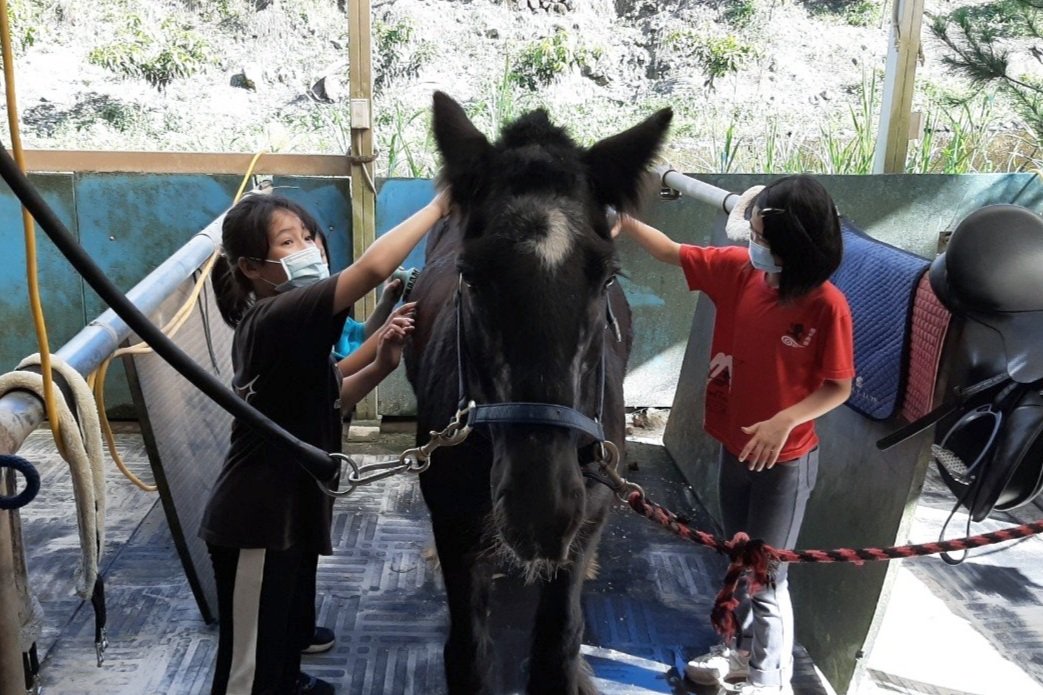
The campus is near an equestrian school, making the "equine studies" class a unique feature of Zhong Keng's practical life education.

Montessori education emphasizes a "prepared environment.” That’s a tall order for Zhong Keng Elementary School, which is located in a remote area, has limited resources, and has experienced the devastation of the 921 Earthquake in 1999.

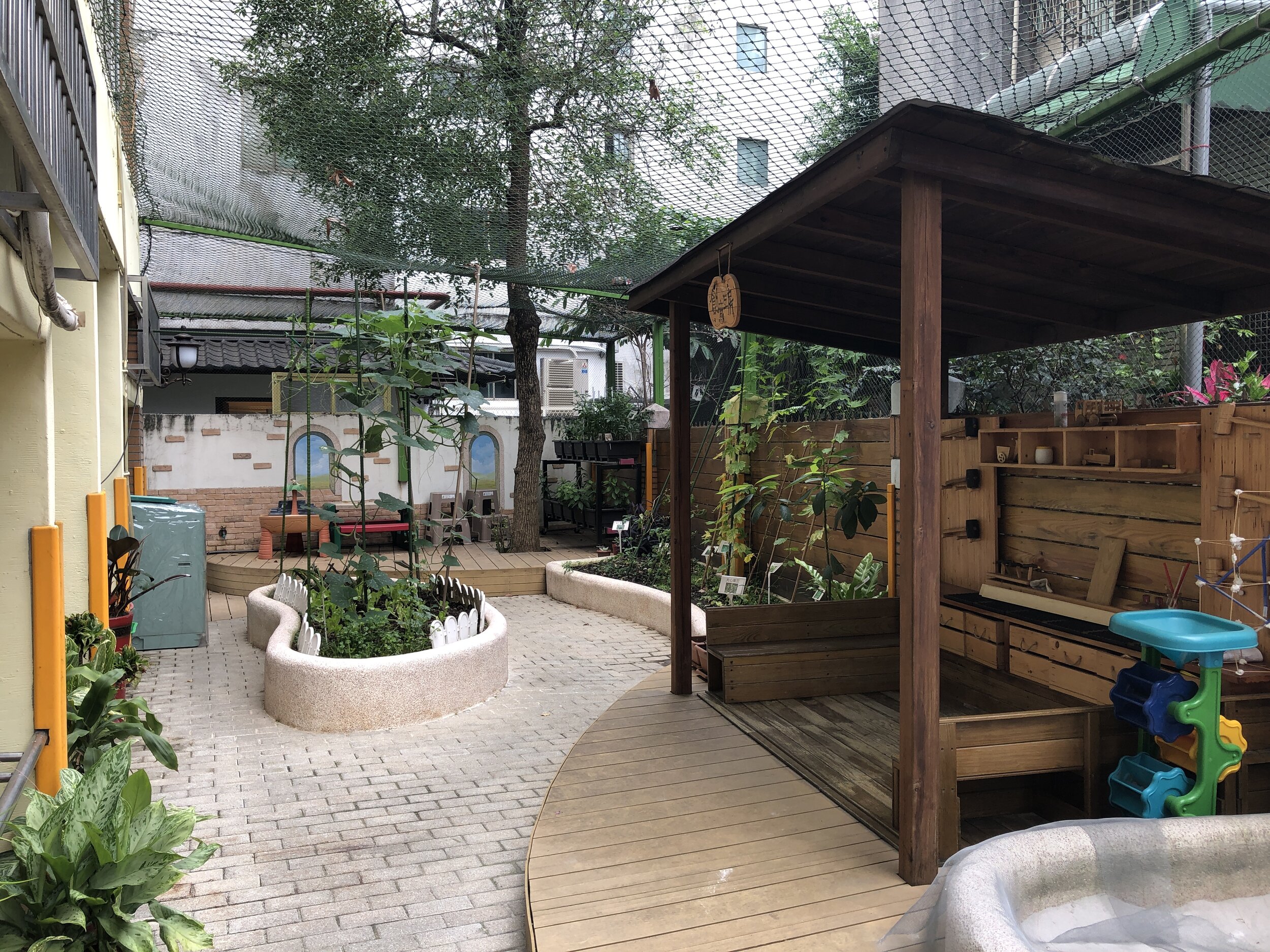
For example, when the school was rebuilt after the disaster, planners based the size of classrooms on small-sized rural schools. The resulting classrooms were comparatively small for Montessori teaching and could not be easily expanded. Other than redesignating the auditorium as an open classroom space, learning space expanded outdoors.

In the end, the original facility, which would be too crowded to house mixed-age students, was fully utilized - every  available corner inside and outside the confines of the classroom are all part of the learning environment.

What’s more, there’s an equestrian school nearby. One of the “work” for these “cosmic children” is to learn about horse-related knowledge, such as horse health and diet, how to curry a horse’s coat, how to clean stables, precautions for riding and leading a horse, horse mathematics, and even the relationship between horses and human history and culture.

Teaching from the perspective of cosmic education expands children's learning and broadens their horizons. The "equine studies” class has unexpectedly become a unique feature of Zhong Keng’s life education.

For Accessible Montessori education to succeed, relying solely on the strength of the school itself is not enough. With the support of a dedicated group of parents and a teaching team unafraid of challenges and committed to continuous learning, Montessori can be implemented step by step, which in the case of Zhong Keng, has allowed Montessori education philosophy to take root.

"No environment can ever be fully prepared. There are always constant adjustments and adaptations.” Zhong Keng’s transformation has just begun, says Ms. Chang.

She hopes that after the process has been completed, Zhong Keng Elementary School will truly become "a school that "connects all things with love," where teachers and students will inwardly explore how to become warm and loving human beings!

Written by Yu-Hsiu Su
Images provided by Zhong Keng Elementary School
Translators: Robert Fox, Jen Hsu/Graduate Institute of Translation and Interpretation, NTNU

Zhong Keng Elementary School: Emerging Metamorphosis (2-1)

interview with Ching-Wen Chang, Principal of Zhong Keng Elementary School, Taichung

I walked into Zhong Keng Elementary School in Taichung City’s Heping District on a warm winter afternoon. There were no sounds of students reciting lessons on the quiet campus—all that could be heard was the wind blowing on treetops.

In such stillness, it wouldn’t be unusual for one to think the students are sleeping. Peering through a clean and clear window pane on the first floor, I saw children in the middle and lower grades concentrating on completing the tasks at hand.

They were orderly and relaxed, an utterly captivating sight of one of the nation’s first public Montessori experimental elementary schools.


The decision from Jena Plan to Montessori

Inspired by the beauty of the Montessori concept, principal Ching-Wen Chang says she hopes that teachers will no longer have to walk the road of educational transformation alone thanks to the professional development and support provided by TMEC’s Accessible Montessori Program.

Before switching to Montessori in 2020, Zhong Keng was already an experimental elementary school, which followed the Jena Plan educational system and adopted mixed-age teaching.

However, it was relatively difficult to grasp Jena Plan’s core spirit. Most instructors had to rely on personal experience alone to resolve challenges of teaching students at varying levels.

"We didn’t completely understand the Jena concept. We were mixing ages just for the sake of mixing ages,” said Zhong Keng principal Ching-Wen Chang, who took office in 2019.

Seeing the teachers’ and students’ predicament, Ms. Chang wondered whether change was possible. Her internal voices must have been heard, for an opportunity soon appeared.

Proactive and conscientious, Ms. Chang was studying Adler's positive psychology when the school was about to apply for a continuation plan that required them to delineate their education philosophy.

Seeking advice, she consequently spoke with Professor Tung-Lian Cheng of National Chengchi University.

After reading Montessori Today, a book the professor had recommended, she was moved by the Montessori approach to education. "This beautiful concept is worth trying," she said.

Never one to sit idle, the principal immediately packed her bags and travelled with a colleague to Taipei, paying their own way, to attend “Montessori Education in Public Schools,” an experiential camp hosted jointly by the Y2 Foundation for Future Education and the National Chengchi University—Taiwan Montessori Education Center (TMEC) in August 2020.

They also attended “Accessible Montessori Education Program,” a seminar that explained its application process. Ms. Chang continued to hold discussions with teachers, parents, and scholars, working hard on weekends and holidays to draw up a plan. The school passed the preliminary review in September of the same year.


Empowering parents to be strategic partners in change

The school’s parent association and volunteer group played a key role in bridging Zhong Keng’s smooth transition to Montessori education.

The law of attraction worked its magic at Zhong Keng. The "Accessible Montessori Education Program" cultivated a new direction for the school. No more would the teachers vacillate between traditional and experimental methods.

More importantly, TMEC provided the teachers with professional training and support so they would no longer feel isolated or hesitant in the practice of their profession.

Change takes a commitment to teamwork and planning. Despite Ms. Chang’s enthusiasm, transitioning to Montessori education was no simple matter. It meant re-empowering teachers and spending more time training them.

Moreover, teachers also needed to change their attitudes and values. They also need to effectively communicate with parents; none of these changes came easy.

How was all this to be done? After much thought, Ms. Chang approached it from two angles. First, she sought out parents supportive of the concept, with whom she shared Montessori’s educational philosophy.

She also explained the changes it might bring to the children and what adjustments teachers would have to make. After obtaining the parents' association’s approval, a LINE group was formed, and the association president and other members assisted the school in communicating with all parents in answering their questions.

The parent group's efforts smoothed the transition from Jena Plan to Montessori. "We helped the school provide answers to some preliminary questions, which allowed teachers to focus themselves on improving their teaching methods,” said Guan-Yin Liu, the vice president of the parents’ association.

How would the school assure parents? Ms. Chang believes that: “Children’s changing behaviors is the best way to convince parents.” When children no longer say profanity, run out of class for no reason, and proactively asks questions and tries to find answers when they go home from school…all these seemingly minor changes gradually convince parents to feel at ease to leave their children’s education to the teachers.

Not only did new students enroll in the school, there are parents, who drive 40km daily to send their child to Zhong Keng. Currently, the lower elementary class is at full capacity of 30 students, which is an all time high for the school.

Moreover, Zhong Keng’s Facebook posts give parents peeks into their children’s school lives. Ms. Chang believes in the concept that "the best ideas need to be disseminated."

Using Facebook to document and share the results of Montessori education is an open and transparent way to relieve any concerns parents might have.


Parents' True Confessions


The importance of Zhong Keng parents for the school’s successful transition to a Montessori educational program cannot be overstated. Countless parental concerns needed to be discussed: "Why do you want to transform the school? What will happen after the transition to Montessori? How will it impact will the children?"

Zhong Keng Experimental Primary School’s parents' association and the volunteer group were crucial for bridging the gap between the parents’ concerns and the school’s objectives, reducing considerably the time administrators would have had to spend answering parents' questions individually.

Parents’ association head Sheng-Hung Liao is a Zhong Keng local opposed to the idea of rote learning. He bases this attitude on trust and letting go. He notes how traditional learning relied on repetition and drilling, whereas Montessori education uses cross-subject projects for learning.

More importantly, Montessori schools empower children to find solutions on their own. “When we don’t have an answer to our children’s questions, they will go to their teachers for help or learn to solve them on their own. Parents need to be patient and let it play out,” Liao says and then suggests with a smile that we also need to remind grandparents from time to time to be hands off on academic learning but keep their eyes on their grandchildren’s behavior.

Zhong Keng Parents’ association’s vice president Guan-Yin Liu, whose children were recipients of Waldorf kindergarten education, notes: "In experimental education, parents must be willing to give up drilling and repetition and let their children educate them."

Because the Montessori teacher's materials and methodologies are entirely different from how the parents learned in school, mothers and fathers become very anxious when faced with this new approach. Guan-Yin Liu believes in the need for them “to have trust in both the school and the teacher."

Even though the initial transition from Jena Plan to Montessori was a bit chaotic, Principal Chang, nevertheless, still set aside considerable time and is dedicated to communicate the process to the parents: “They just want to see the changes Montessori education can bring their children and hope that experimental education is not an experiment on their children.”

Parents’ association’s vice-president Tsui-Ying Hung stresses that parents need to have faith in the school's professionalism, even if parents sometimes do not understand how the curriculum is organized.

For instance, a first-grade material was covered one week, but switched to a second-grade material the following week. It is only after seeing how their children became more immersed in the material did parents realize the teacher’s intent. The parent group ultimately decided it be best to "go with the flow" and refrain from interfering with the methods or progress of teaching.

>> Zhong Keng Elementary School: Emerging Metamorphosis (2-2)

Written by Yu-Hsiu Su
Images provided by Zhong Keng Elementary School
Translators: Robert Fox, Jen Hsu/Graduate Institute of Translation and Interpretation, NTNU

KNOCK-KNOCK, OPEN THE MYSTERIOUS DOOR OF A MONTESSORI MIDDLE SCHOOL (2-2)

What is most impressive about Y2MAC is the level of dedication shown by the guides. They hold nothing back and invest almost all of their energy into the students, observing them with a level of detail that even the students' own parents might not match…

Every child is a genius

陳慧君老師(透過蒙特梭利教具協助,可將抽象概念具體化)IMG_7544.JPG

Adolescence is a time when the human body and mind undergo tremendous change. The million-dollar question for middle school teachers is how to balance high academic pressures and children’s developmental needs.

Fortunately, a group of children under the guidance of Montessori-trained educators are working to achieve that balance. These children have developed almost computer-like ability to sift through and synthesize information. Moreover, they have the opportunity to learn the art of socializing through the experience of boarding. According to Chen Hui-Chun (Chen), director of the Green Shepherd Montessori Elementary School in Taichung, “conventional education focuses on the assessment of teaching results through homework and exams. Montessori education works through teacher demonstration and group discussion of a concept. It doesn’t offer one correct answer to any question. On the contrary, students are encouraged to find their own answers through the process of preparing oral presentations, in which students can share their findings with others.”


Montessori is an aid for neurological development


 “Every child is a genius. It’s just that often times, different education methods may overshadow their brilliance,” describes Chen. When Chen’s son was in preschool, he questioned why Seran wrap clung to surfaces but not to hands. When a six year-old child asks a question, which requires high school physics to solve, Chen explains that as the adult, she cautiously & closely worked with her son to discover the answer together. In order to provide her son with room to learn more freely, Chen begins to explore Montessori elementary school education. Little did she know that this choice will later change the path of her career.


At the time, Chen was working as a medical technician specializing in cytopathology. When her son received Montessori education in early childhood, Chen recognized that this type of learning clearly aided neurological development. In 2013, she funded her own tuition and attended the AMI Montessori Elementary Teacher Training program, diving into the field of education.


“Initially, there weren’t any organizations like Y2 Foundation for Future Education. Most teachers took out loans to pay for their training,” expressed Chen. She decided to take the elementary Montessori course, because she was interested in its core concept of “cosmic education.” She wondered how the teacher can, at each stage of development, motivate the students to willingly learn through repeated practice—all the while engaging the children’s learning and interest to build a solid academic foundation. This way, the students can make a smooth transition to secondary school, where learning is much more abstract.


Different goals for different stages of education

陳慧君老師(讓孩子在生活中,體會動手做的樂趣) S__6578192.jpg

 “Fortunately through the Foundation’s sponsorship, I am able to attend the AMI/NAMTA Orientation to Adolescent Studies program in 2018, which enabled me to have a more comprehensive and macro level understanding of the Montessori Method. Through discussions and working with teachers at the Green Shepherd Montessori Elementary School, we made adjustments to how to implement Montessori theories. Whereas in elementary school the goal is to inspire interest, in the middle school curriculum, we incorporate interdisciplinary and practical application of various subjects to project-based learning, where students can practice and participate in civil society.”


During her time training abroad, Chen saw that the children of Taiwan will face global competition. Both the challenges and opportunities awaiting them are unknown. According to Chen, “adults, therefore, should be guides rather than teachers.” Dr. Montessori believed that every child has an inner teacher, who guides the child to self-learn. Teachers are encouraged to spend more time to observe children and provide only the necessary guidance and resources.


Montessori education has been practiced around the world for over a century. Today, it offers the gift of enabling children to develop the ability to identify resources and acquire a macro perspective within their own surrounding environment. Through ”place-based learning,” the Montessori Method prepares children’s character and skillset so that they are ready for globalization in the future.


This article is an excerpt from Y2 2019 Annual Report.

Child-centered education promotes independent thinking

%E6%86%B2%E7%82%BA%E8%80%81%E5%B8%AB%EF%BC%88%E8%B5%B0%E5%87%BA%E6%95%99%E5%AE%A4%EF%BC%8C%E8%AE%93%E5%AD%A9%E5%AD%90%E5%BE%9E%E7%94%9F%E6%B4%BB%E8%BB%8C%E8%B7%A1%E5%9F%B9%E9%A4%8A%E4%BA%BA%E6%96%87%E6%80%9D%E7%B6%AD%EF%BC%89.jpg

The teacher of a child-centered approach to education attends to each child’s own skill level and pace of learning. An elementary school teacher must consider this aspiration in conjunction with preparing the students to transition to middle school. If you are an elementary school teacher, how would you manage a mixed-age classroom, while ensuring the curriculum truly matches the learning needs of every child?


Teaching & learning: for children to be proactive

IMG_8039.jpeg

“Going to school is so much fun, like going on holiday!” It is because of this declaration from his daughter that Lee Hsien-wei (Lee) decided to train as a Montessori teacher.  Lee is now a teacher at the Harvard Montessori Elementary School in Tainan. When Lee’s daughter first began kindergarten, she was often reluctant to go, but her resistance went away completely when she moved to a Montessori preschool a year later. Inspired by the change in his daughter, Lee accepted the invitation of Hsieh Fu-chue (then director of the Harvard Montessori Preschool) to co-found a Montessori elementary school.


Montessori elementary school teachers need to have many skills up their sleeve. “Thanks to the grant provided by Y2 Foundation, I was able to attend the 2017 AMI Montessori Elementary Teacher Training program in the US. When combined with my experience of working in the new elementary school project during its first two years, the training is extremely helpful to my teaching. I am truly convinced that if you give children freedom and respect, they will be proactive learners.”


As the AMI elementary training takes three summers to complete, Lee found that the training broadened his horizons even further each year. From the initial focus on teaching aids, the course gradually expanded to a deeper understanding of the Montessori philosophy.

 
“Teachers need to know how to make good use of the teaching aids and understand how these materials can help turn abstract concepts into something concrete,” Lee explained. “But more importantly, it’s about the balance between teaching and learning. Teachers need to give just enough information to stimulate students’ interest but not too much that they get bored. It’s about how to motivate the students to do more research and to dig deeper.”


During the history lesson, for instance, after Lee made a brief introduction to the history of Taiwan, some students became interested in and proactively began to study the names of roads in Tainan before turning their attention to the historical city walls and gates. The students discovered there were remains of old city walls within Tainan Park and about the relocation of the Lesser West Gate. “The children understood how hard our ancestors worked to build the city walls and the love and heritage that have been passed down from generation to generation. While they felt sad about tearing down the old city walls due to practical necessity, the children also had an opportunity to reflect on the trade-off between the preservation of history and culture versus economic development. This kind of appreciation and critical thinking can’t be learned from textbooks or lectures alone.”


Self-directed learning vs. rote memorization


In order to transition to the next level of education, Lee believes Montessori elementary school teachers have the responsibility to help children learn, at a minimum, all the skills conventional elementary schools deliver. To help ensure children can smoothly move from Montessori elementary to secondary school, Lee attended the AMI/NAMTA Orientation to Adolescent Studies program (for ages 12–18) in 2019.


For Lee, guiding children to think critically about What is the purpose of learning? What is meaning of life? is much more important than the mere transmission of knowledge. He has seen many children, whose smiles are stifled by exam pressures, even to the point that some say they no longer know what they’re living for. This is why Lee is more convinced than ever about the importance of Montessori education.


“Artificial intelligence is bound to replace many skills that we teach in traditional education. We have to go back to the basics and foster children’s self-driven interest and motivation for learning,” according to Lee. “More importantly, we have to enable children to appreciate all aspects of what they inherited from nature and all of the love and cultural heritage of our ancestors. This is so that children can begin to think about what it means to be human and the role they each can play. I believe this is the true purpose of education.”


This article is an excerpt from Y2 2019 Annual Report.

A Montessori preschool in Wanhua - A new kind of education blooms in the old quarters of Taipei

IMG_3581-蒙特梭利教育不分經濟優劣所能帶來的改變,讓荒漠也能開出一朵美麗的教育花.JPG

What comes to mind when you think of Wanhua? A historic neighborhood? Longshan Temple? Snake Alley?What do you imagine a Montessori school would be like? Expensive? Lots of teaching materials? Different from traditional schools?

A new type of education is flourishing in the old neighborhood of Wanhua. Children, parents, and the local community are all benefiting from Montessori philosophy in ways that are gradually bringing change.


From failing to star preschool

 
Back in 2012, after integrating its kindergarten and nursery school, the Taipei Municipal Wanhua Preschool was left with unfilled student vacancies. Things began to change after Hui-Ling Lu was selected by the Taipei Department of Education to be the new director. The once unpopular preschool now has hundreds of families on the waiting list. The preschool’s transformation results from integrating the Montessori Method into the existing curriculum. The key to the school’s success was Director Lu’s commitment to create a prepared environment for the children and to prepare teachers during the change.


Upon walking into Wanhua Preschool, the bright, spacious rooms feel like a private preschool. The children are all busy doing something: some squeezing lemon juice to share with others, another concentrating on the Addition Snake Game, while a group of children are working on a geography jigsaw puzzle. The teachers are not shouting “Quiet!” or “Sit down!” Instead, there is a serene learning atmosphere. Here, learning to live and learning knowledge are one in the same, as order, logic, and life skills are all integrated.


Education absolutely changes children

 
Director Lu of the preschool has gotten used to visitors being astonished and moved by what they see. “Because of where we are, half of the children in our preschool come from underprivileged families. As we transitioned to the Montessori model in 2015, our biggest challenge was to help these children enjoy learning and to help children with special needs find their place in the educational system.”


In fact, many of these “special needs” children simply lacked cultural stimulus. To help them, Director Lu applied for assistance from special education professionals, who’d come in to support these children and to assist their smooth transition to formal elementary school education. “This situation is just like when Maria Montessori set up the first Children’s House in Rome,” remarked Director Lu. Montessori believed that education can change children. Education provides children from disadvantaged families with more cultural stimulus, while other children have the opportunity to learn even more. Education is not about requiring all children to reach the same standard.


Putting children at the center of learning

98148931996277-在準備好的環境中,小小孩們各安其所.jpg

At the Municipal Wanhua Preschool, teachers are always attentive, observing children as they progress through different stages. For example, once the teachers overheard children talking about how eggs hatch into chicks. The next day, without saying anything, the teachers placed five eggs in the classroom. The children who found the eggs were delighted and started to talk about how to hatch them, coming up with lots of ideas, including lamps, thermometers, and chicken nests. In the end, three chicks hatched.


But what next? The teachers followed the children’s curiosity and responded by asking all sorts of questions: How should the chicks be raised? Where should they live? What do they eat? What if there are rats? The children wrecked their brains and tried to find solutions together. They even used Lego bricks to build a model chicken coop and asked the Director to find a carpenter to build it. Now, the third generation of chicks have been born.


“I think what’s great about Montessori education is that it respects children and doesn’t have standardized teaching materials,” explained Director Lu. “Teachers provide education that suits each child’s individual needs. But it’s very important to have teachers who are prepared, because they have to observe, wait, and think about when to give, what to give, and how to prepare children for what’s next.”


Teachers impact children’s lives


At first, the teachers were uncertain about integrating the Montessori Method into the curriculum, but Director Lu encouraged them to try. “The teachers love the children as much as I do,” illustrated Director Lu. “At the end of the day, we all just want to do more for them.”


Director Lu continued to motivate the teachers by assuring, “You can impact the children’s lives.” Because of these teachers, who are not afraid to try new things and willing to spend their own holidays doing 360 hours of local Montessori teachers’ training, many underprivileged children now have the opportunity to benefit from this change. What’s more, the affect upon the children has also led to changes in their families. “Our child learned to clear the table and even reminds us to do it now!” exclaimed a parent with a smile.


“The Montessori Method is actually an education model, not a technique. Children are born with the innate disposition to self-learn, and they can expand their intelligence through learning, as long as we’re willing to offer them the opportunity,” according to Director Lu.


The success story of the Wanhua Preschool exemplifies the change Montessori education can bring, regardless of families’ socio-economic status. A new kind of education continue to flourish in an old neighborhood.